


Juul Carlsen
In the autumn and winter season of 2026, d'Angleterre has the pleasure of exhibiting the works of Danish artist Juul Carlsen in Marchal and Upper Lobby.
Juul Carlsen is originally trained as an architect but is self-taught as a painter. His work draws on everyday elements, architecture, landscapes and historical fragments, which he translates into cohesive compositions on linen.
With an architect’s eye for form, space and composition, he works intuitively with colour, brushstrokes and movement to create works that, above all, invite a sensory experience.

Artistic practise
How would you describe your artistic style in a few words?
My starting point is to create an atmosphere, or perhaps more accurately, a sensory experience. I try to keep the painting open, so that I do not impose a particular interpretation on the viewer. At the same time, I am very conscious of creating a sense of dynamism within the image – of keeping it alive and in motion.
For me, a work is not only about the subject matter, but just as much about colour, brushstrokes, temperament and the energy that lies in the hand as I paint. It is the interplay between these elements that gives the work its life.
Are there any artists, movements, or styles that have had a significant influence on your work?
My education as an architect, and particularly my studies of Italian architects, is a major source of inspiration for me. I admire the way they work with compositions and collages, and that approach has had a great influence on the way I look at an image myself.
As a child, my parents often took my siblings and me around Europe to experience art. Monet made a particularly strong impression on me, not least because we had the opportunity to visit his home and garden in Giverny. It was an incredible experience that I still think back on.
Can you explain any unique techniques or approaches you use in your art?
The construction of my paintings takes its material starting point in acrylic and is finished with a refinement in ink. It is a process in which the work gradually takes shape through different layers and materials.

What themes or concepts do you explore in your art? Are there recurring motifs or subjects?
I work extensively with composition, form and colour, and I have always been particularly fascinated by these three elements. This can perhaps be explained by my background as an architect. Aesthetics certainly plays an important role in my art, and my starting point is almost always to create something that I find beautiful to look at, and that brings a particular atmosphere to the person viewing it – or to the space in which the work exists.
In addition, there are three central elements that recur throughout my work, which I combine in different ways that I find interesting: nature, abstract forms and architecture.My work almost always takes shape from one of these three elements. In some works, nature dominates; in others, it is the forms, while at other times I combine them. But these three elements are almost always present in my work.
My works can emerge from all kinds of things I see – things that spark an idea in me. At the moment, I am working extensively with landscapes and nature and therefore find a great deal of inspiration there. It can come simply from being in nature, but also through film. For example, I watch a lot of Disney films with my son, which I find very inspiring.
I also like to incorporate fragments of buildings into my paintings, and here, naturally, I draw a great deal of inspiration from architecture. I am particularly inspired by ancient columns, which can be found throughout Southern Europe, as well as by the use of tiles in Danish retro architecture.

Have there been any significant milestones or experiences that have shaped your artistic journey?
My childhood in Tanzania has certainly had a profound influence on me as an artist – the colours, the landscape and the sounds.
Later, I had a very special teacher who encouraged me to paint things and then describe them in writing as a way of dealing with my dyslexia. My starting point for writing therefore became to first draw or paint something. In many ways, that is why it is my primary language.
Who do you create art for, and what do you hope viewers take away from your work?
My paintings do not necessarily have a deeper symbolic meaning. I work with symbolic elements, such as nature or particular colours that may carry symbolic associations, but my primary focus is on creating atmospheres and emotions in the viewer.
Ultimately, however, it is entirely open to interpretation what one takes away from a piece of art. A viewer may bring something to one of my paintings that I had not intended or considered beforehand – and I think that is wonderful. To me, art should very much be a starting point for conversation.

Dive in deeper
Explore the works of Juul Carlsen via Instagram.
For prices, see list of art works.
For more questions, please contact our front desk or Marchal team.
Inspiration everywhere
d'Angleterre is a treasury of art and a hub for exciting cultural events year-round.
Explore universe Explore universe
Louise Langgaard
In the summer of 2026, d'Angleterre had the pleasure of exhibiting the works of Danish artist Louise Langgaard in Marchal and Upper Lobby.
Carl-Henning Pedersen
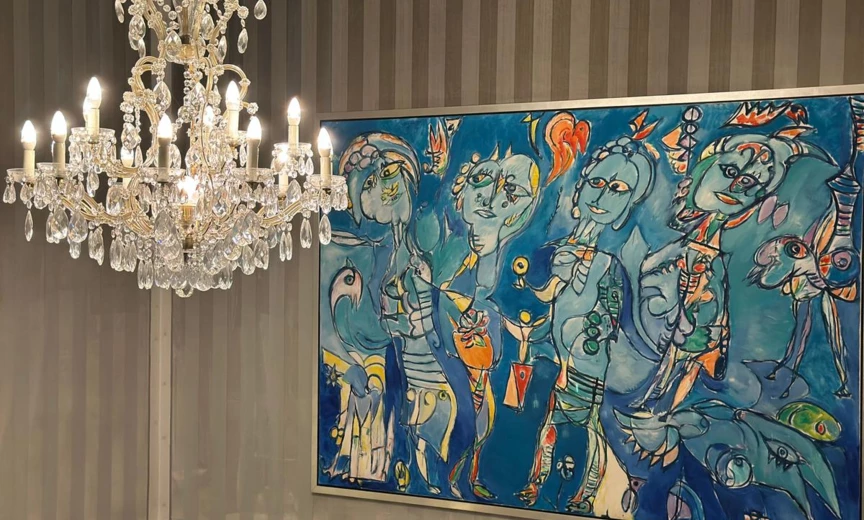
d'Angleterre is honoured to be exhibiting a curated selection of artworks by the renowned Danish artist Carl-Henning Pedersen. The paintings are on loan from Carl-Henning Pedersens Fond and will adorn the hotel for five years, from 2025 to 2030.
Be the first to know
Sign up for our newsletter and be the first to know about exclusive events, special experiences, and more at d’Angleterre.